















Is Online Therapy Effective? Here is What the Research Shows

Online therapy was a niche option a decade ago and became a default option during the pandemic years. What has not kept pace with its adoption is a clear public understanding of whether it actually works, or whether it is simply a lower-effort substitute for “real” therapy. The short answer, supported by a substantial body of research at this point, is that online therapy is effective for most common concerns, with some important conditions attached. This article works through what the evidence shows, where online therapy holds up best, and where in-person sessions may still be the better fit.
What the research says, specifically
A large individual-patient-data meta-analysis examining internet-based cognitive behavioural therapy for depression found outcomes broadly comparable to face-to-face treatment across a wide range of patient characteristics (Karyotaki et al., 2021). Reviews of internet-delivered psychological treatment more broadly have reached similar conclusions across anxiety, depression, and several other conditions, with effect sizes in many studies approaching those of in-person therapy (Andersson, 2016). This does not mean every format works equally for every person, but it does mean the assumption that online therapy is inherently a lesser option is not supported by the evidence.
Why the format works as well as it does
Therapy’s active ingredients, the therapeutic relationship, structured techniques, and consistent engagement, do not depend on physical proximity in the room. Video call sessions preserve tone of voice, facial expression, and real-time interaction, which are the elements most closely tied to therapeutic alliance. What online therapy removes is commute time, the logistical barrier of getting to a clinic during work hours, and for some clients, the added anxiety of an unfamiliar physical space, all of which can make consistent attendance more realistic rather than less.
Where online therapy particularly makes sense
For people managing anxiety, depression, stress, or relationship difficulties without an acute safety concern, online sessions are well supported and often more sustainable long-term, since missed sessions due to traffic, work schedules, or travel are less likely. It is also a practical option for people outside Lahore, for the Pakistani diaspora seeking a therapist who understands local and cultural context, and for anyone who prefers the added privacy of not being seen entering a clinic, which remains a real consideration given the stigma that still surrounds seeking mental health support in much of Pakistan.
Where in-person sessions may be preferable
Severe presentations involving risk of self-harm, active psychosis, or situations requiring close physical monitoring generally require in-person or higher-intensity care, since online delivery is not designed for crisis management. Some clients also simply do better with the structure of leaving the house and being in a dedicated therapeutic space, and that preference is a legitimate factor in choosing a format, not just a research variable.
What a session actually looks like
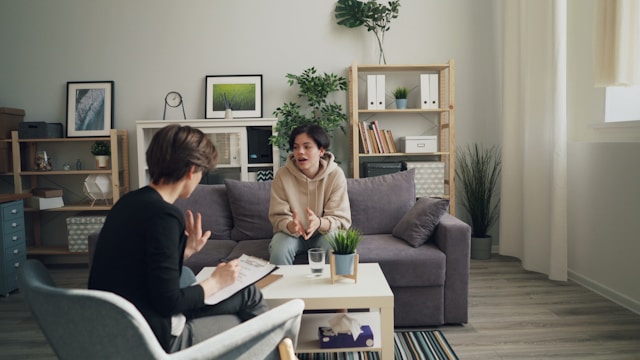
A typical online session at The Psychology Square runs over video call, at a scheduled time confirmed by email, from wherever you have a private, quiet space with a stable internet connection. No specialised software download is required beyond a standard video call link. The intake process, confidentiality standards, and clinical approach do not differ from in-person sessions; the only change is the delivery channel.
How online sessions handle the intake process
The intake process for online therapy follows the same structure as an in-person first session: background gathering, discussion of your current concerns, and agreement on initial goals for the work ahead, conducted over video call rather than in a room together. Some clients worry that a screen makes this process feel less thorough, but the content and depth of the intake do not change based on format; what changes is only the physical setting in which the conversation happens.
Addressing the common doubts directly
A frequent concern is whether a screen creates emotional distance that makes disclosure harder. In practice, many clients report the opposite: being in a familiar space, such as their own room, lowers the initial anxiety of a first session compared to an unfamiliar clinic waiting room. Another common doubt is whether a therapist can pick up on nonverbal cues over video. Trained clinicians are generally attentive to tone, pacing, and facial expression regardless of medium, and will ask directly when something in a session feels unclear rather than relying solely on visual interpretation.
Confidentiality in an online format
Confidentiality standards apply identically to online and in-person sessions, with the same legal exceptions, such as risk of serious harm to yourself or others. What online sessions add is a personal responsibility on the client’s side: joining from a private space where the conversation cannot be overheard, and using headphones where needed, is part of making the format work as intended.
Data and privacy safeguards specific to online sessions
Encrypted video call infrastructure and secure storage of clinical notes are standard expectations for a legitimate online therapy provider, and it is reasonable to ask a prospective provider directly how session recordings, if any, and written notes are stored and who has access to them. At The Psychology Square, video calls and written communications use encrypted infrastructure, clinical notes are stored securely, and information is not shared without explicit written consent, with the standard exceptions that apply to therapy generally, such as an assessed risk of serious harm. Sessions are not recorded by default, and if that were ever to change for a specific purpose, it would require your explicit agreement beforehand rather than being assumed.
Cost and accessibility
Online therapy at The Psychology Square is priced the same as in-person sessions, at PKR 5,000 for individual therapy and PKR 7,000 for couples therapy, removing the cost differential that sometimes exists between formats elsewhere. For clients weighing whether the convenience is worth it, the pricing parity removes one variable from that decision entirely.
Technology requirements and what to check beforehand
Online sessions require a stable internet connection, a device with a camera and microphone, such as a phone, tablet, or laptop, and a private space where you will not be interrupted or overheard. Headphones are recommended, both for audio clarity and for an added layer of privacy if others are present in the house. It is worth testing the video link a few minutes before the scheduled time, particularly for a first session, so that any connectivity issues are resolved before the session itself begins rather than eating into the appointment time.
What tends to surprise first-time online therapy clients
Clients who were sceptical about the format beforehand often report two things that surprised them afterward. The first is how quickly the video call format stopped feeling unusual, typically within the first or second session, once the conversation itself became the focus rather than the medium. The second is a level of comfort that some clients did not expect: being in a familiar space, on their own terms, without the social performance sometimes involved in getting to and sitting in an unfamiliar clinic. Neither observation is universal, and some clients continue to prefer in-person sessions throughout, which is a legitimate preference rather than a sign that online therapy failed to work for them.
Choosing the right format for your situation
If you are undecided, a reasonable way to choose is to consider two questions directly: does your situation involve a level of risk or complexity that would benefit from in-person monitoring, and does the added convenience of an online session materially increase how consistently you would actually attend. For most people managing anxiety, depression, stress, or relationship concerns without an acute safety issue, the second question tends to matter more in practice, since consistency across sessions is one of the stronger predictors of good outcomes in therapy generally, regardless of format.
Online sessions for people living with extended family
A specific and common concern in Lahore is privacy when living in a joint family household, where finding an uninterrupted, private hour can be genuinely difficult. This is worth raising directly with your psychologist rather than treating it as a reason to avoid therapy altogether; many clients work around it by scheduling sessions during hours when the household is quieter, using headphones to keep the conversation from being overheard, or, in some cases, choosing an in-person session for weeks where privacy at home is not realistic. The format is flexible enough to accommodate this kind of constraint, provided it is discussed openly rather than left to create recurring last-minute cancellations.
Making the decision
If your main hesitation about therapy has been logistics, travel time, or discomfort with being seen at a clinic, online therapy addresses each of those directly without a meaningful trade-off in effectiveness for most common presentations. If your situation involves risk or a need for closer monitoring, that is worth discussing directly with a clinician, who can advise on the most appropriate format for your specific circumstances.
You can book an online therapy session directly, or read more about how therapy works at The Psychology Square before deciding which format suits you.
References
Andersson, G. (2016). Internet-delivered psychological treatments. Annual Review of Clinical Psychology, 12, 157–179.
Karyotaki, E., Efthimiou, O., Miguel, C., Bermpohl, F. M. G., Furukawa, T. A., Cuijpers, P., Individual Patient Data Meta-Analyses for Depression (IPDMA-DE) Collaboration. (2021). Internet-based cognitive behavioral therapy for depression: A systematic review and individual patient data network meta-analysis. JAMA Psychiatry, 78(4), 361–371.
World Health Organization. (2023). Depressive disorder (depression). https://www.who.int/news-room/fact-sheets/detail/depression