

















Locus of Control - Worksheet
Free printable Locus of Control worksheet — identify which outcomes you can influence and which you can't, to build self-awareness and agency.
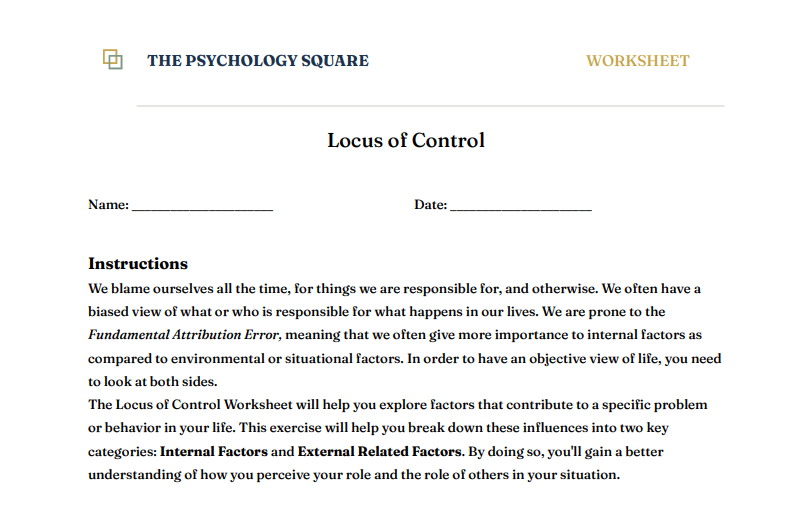
Locus of Control Worksheet
The Locus of Control Worksheet from The Psychology Square is a structured psychology resource designed to help individuals develop greater awareness of how they understand responsibility, influence, and control in challenging situations. When something goes wrong, it can be easy to place responsibility entirely on ourselves or, alternatively, attribute the outcome primarily to circumstances outside our control. This worksheet provides a framework for examining these influences more objectively.
What Is Locus of Control?
Locus of control refers to the way individuals perceive the relationship between their own actions and the outcomes they experience. In everyday life, people may differ in how much influence they believe they have over particular situations.
The concept can be useful when examining personal responsibility, decision-making, self-awareness, and responses to difficult circumstances. The worksheet specifically encourages consideration of both personal and environmental influences rather than automatically assigning responsibility to one side.
This makes it a potentially useful resource for exploring how a person interprets a specific problem, behavior, or challenging situation.
Internal and External Influences
Situations are rarely determined by a single factor. Personal characteristics, actions, choices, circumstances, other people, and environmental conditions can all influence what happens.
The Locus of Control Worksheet provides a structured way to consider these different influences and examine the degree of control associated with them. This can encourage more nuanced thinking about responsibility and influence rather than relying on an overly simple interpretation of events.
The purpose is not to assume that every situation is completely within your control. Instead, the exercise can help distinguish between factors that may be influenced and factors over which a person has limited or no control.
Who Can Use This Worksheet?
This locus of control worksheet may be useful for:
- Individuals engaging in personal self-reflection
- People trying to understand their responses to challenging situations
- Clients working on self-awareness in therapy
- Psychology students studying locus of control and attribution
- Mental health professionals using structured reflective exercises
- Individuals working on personal growth and problem-solving
It can be particularly relevant when someone is uncertain about how much responsibility they should take for a particular outcome or is struggling to distinguish between controllable and uncontrollable circumstances.
Locus of Control and Personal Growth
Developing awareness of perceived control can be relevant to personal growth, problem-solving, decision-making, behavioral change, and psychological self-awareness. Recognizing what can and cannot be influenced may help an individual direct attention toward areas where meaningful action is possible.
The worksheet is intended as a structured reflection tool rather than a diagnostic assessment. It may be used independently or incorporated into appropriate clinical, educational, or research contexts.
Download the Locus of Control Worksheet
If you are looking for a free locus of control worksheet, psychology worksheet, self-awareness worksheet, or cognitive reflection exercise, this resource provides a structured way to examine perceptions of responsibility and control.
Use the worksheet to reflect carefully on a situation and consider the different influences involved. The aim is to develop a more balanced understanding of personal influence and external circumstances, which may support more informed decision-making and constructive problem-solving.
The Psychology Square provides psychology worksheets and mental health resources for personal, clinical, educational, and research use.
This worksheet is provided for personal, clinical, and research use only. Reproduction, resale, or claims of ownership are not permitted.