


















The Availability Heuristic: How Your Mind Tricks You Into Bad Decisions
The Availability Heuristic: How Your Mind Tricks You Into Bad Decisions
Understanding the Cognitive Bias Behind Misjudged Risks, Diagnoses, and Financial Choices
Introduction: What Is the Availability Heuristic?
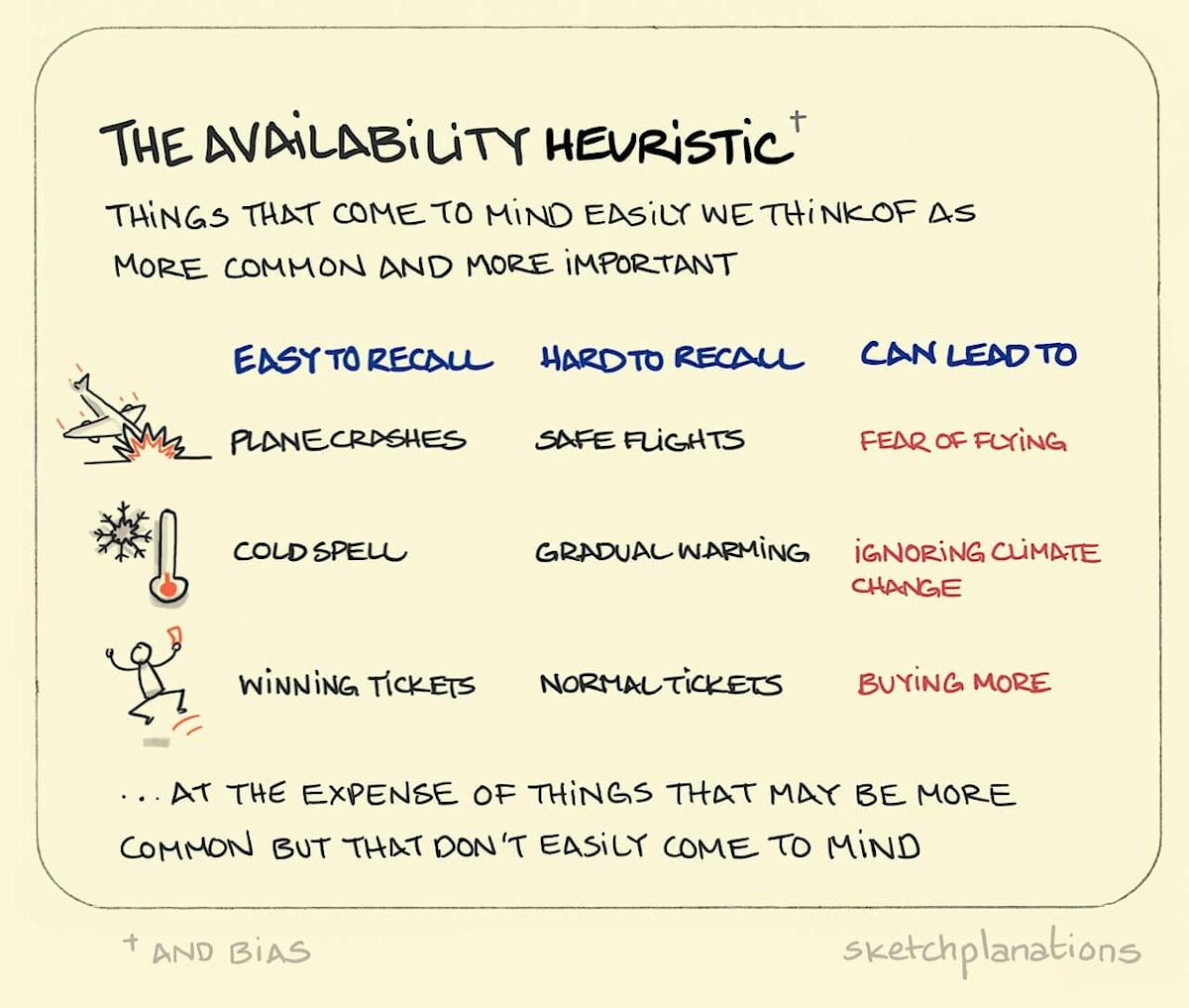
Our brains rely on mental shortcuts, known as heuristics, to make quick decisions without analyzing every piece of available data. One of the most influential of these shortcuts is the availability heuristic — a cognitive bias in which we judge the probability or frequency of an event based on how easily examples come to mind, rather than on actual statistical likelihood.
While this shortcut can be useful in everyday life, it frequently leads to flawed judgments, skewed risk perception, and poor decision-making — in areas ranging from personal safety to medical diagnosis to financial investing. This article explores how the availability heuristic works, where it shows up in daily life, and practical strategies to counteract it.
The Deception of Regularity
Have you ever asked yourself how often you’ve engaged in a risky behavior, like texting while driving? If examples come to mind easily, you’re likely to overestimate how often it actually happens.
This is the availability heuristic in action: we judge frequency not by real data, but by how effortlessly relevant examples surface in memory. The easier something is to recall, the more common — and often more dangerous — we assume it to be, regardless of the actual statistics.
Misleading Notions of Safety: The SUV Example
A widely held belief is that large SUVs offer better protection than smaller vehicles. However, data tells a different story — SUVs are actually associated with higher death rates in certain types of accidents.
Despite this evidence, the perception of SUV safety persists. Why? Because dramatic, memorable images — like an SUV overpowering a smaller car in a collision — are more vivid and easily retrievable than dry statistical facts. This tendency to favor memorable examples over objective data is known as the ease-of-retrieval effect, a close relative of the availability heuristic.
The Impact of Dramatic Incidents on Perceived Risk
Sensational, emotionally charged events tend to dominate our mental “availability,” distorting how we assess real-world risk. Common examples include:
- Fear of flying despite air travel being statistically much safer than driving, largely due to vivid media coverage of plane crashes
- Overestimating homicide risk while underestimating far more common causes of death, such as cardiovascular disease
Media coverage plays a major role here: sensational stories are reported more often and more vividly, making them disproportionately “available” in our minds — even when they don’t reflect actual probability.
The Physician’s Conundrum: Bias in Medical Diagnosis
Even trained medical professionals aren’t immune to the availability heuristic. Research shows that doctors who are frequently exposed to a specific illness may be more likely to misdiagnose future patients with similar — but unrelated — symptoms as having that same condition.
How this happens in practice:
- A physician encounters several cases of a particular illness in a short period
- When a new patient presents with vaguely similar symptoms, the doctor’s mind gravitates toward the familiar, recently-seen diagnosis
- This can lead to misdiagnosis, even when the actual condition is statistically more likely to be something else
This bias highlights why structured, evidence-based diagnostic protocols are so important in clinical settings — intuition shaped by recent exposure isn’t always accurate.
The Availability Heuristic and Financial Risk-Taking
The availability heuristic doesn’t just affect safety perceptions and medical decisions — it also shapes economic and financial behavior, especially during periods of instability.
Key patterns observed in research:
- During economic downturns, people often become more drawn to risky investments, driven by the vivid appeal of potential high returns
- Perceived financial threat has been shown to increase people’s willingness to engage in speculative behavior, such as gambling
- This challenges traditional rational choice theory, which assumes people make consistently logical financial decisions
In short, the emotional vividness of potential rewards can override rational risk assessment — particularly when people feel financially vulnerable.
The Availability Heuristic in Consumer Behavior and Branding
Marketers and brands are well aware of how the availability heuristic shapes consumer perception. When people evaluate a brand, they often rely on whatever examples come to mind most easily — not necessarily the most accurate or representative information.
For example: When asked to recall examples of a brand’s superiority, consumers tend to default to the most memorable or recently-seen examples, potentially overlooking better alternatives that simply aren’t as “top of mind.”
This is precisely why brand visibility, repetition, and memorable advertising campaigns are so effective — they increase a brand’s availability in consumers’ minds, directly influencing purchasing decisions.
Strategies for Overcoming the Availability Heuristic
The availability heuristic is a deeply ingrained cognitive pattern, but it’s not insurmountable. Here are five evidence-based strategies to reduce its influence on your decision-making:
1. Build Cognitive Awareness
Understanding how heuristics work is the first step toward counteracting them. Learning to recognize when a judgment is based on “what comes to mind easily” rather than actual data helps you pause and reassess before acting.
2. Seek Out Diverse Information
Actively seeking multiple perspectives and sources — rather than relying on the first or most memorable piece of information — leads to more balanced, evidence-based conclusions.
3. Rely on Evidence-Based Practice
In high-stakes fields like healthcare and finance, structured frameworks grounded in empirical data (rather than intuition or memorable anecdotes) significantly reduce the risk of biased decision-making.
4. Practice Mindfulness
Mindfulness and reflective practices — such as meditation — help build self-awareness around automatic thought patterns. This makes it easier to notice and challenge biased judgments as they arise, rather than acting on them unconsciously.
5. Embrace Collaborative Decision-Making
Involving multiple perspectives in a decision — whether through team discussions or diverse stakeholder input — helps counterbalance any one individual’s availability bias, leading to more objective outcomes.
Conclusion: Making Wiser Decisions in Spite of Mental Shortcuts
The availability heuristic is a powerful — and often invisible — force shaping how we assess risk, make financial choices, evaluate brands, and even diagnose illness. While this mental shortcut is a natural part of how our brains process information, understanding it gives us the power to counteract its effects.
By building cognitive awareness, actively seeking diverse information, relying on evidence-based practices, embracing mindfulness, and encouraging collaborative decision-making, individuals and organizations alike can navigate everyday judgments with greater clarity, objectivity, and wisdom.